Know all about making the best rubber rollers
Though there is evidence of people using rubber for thousands of years, there is wide use of industrial rubber only in the last two centuries. It is because natural rubber becomes sticky when heated and stiff when cold. It was only by hardening rubber by vulcanization in the 18 century to make it useful in many industries. The global rubber industry market size is growing at a CAGR of 5.1%, from 40.71 billion USD in 2018 to reach 60.38 billion USD in 2026. Rubber is the principal constituent for making tires and also many industrial and printing rubber rollers.
Rubber rollers VS metal rollers
It was during the first industrial revolution that rubber rollers replaced metal rollers. The reason is that rubber rollers have a high coefficient of friction to provide excellent traction in moving parts and components. Apart from all the rubber advantages, these rollers also compensate for the slight changes in machine functions. The significant advantage of rubber is that it gets repeatedly compressed and relaxed without losing its shape. Also, when compared to metal, it is inexpensive and can withstand shocks and resist scratching. And above all, it is a natural product that is recyclable as many times as possible to be most eco-friendly. It is why many people use rubber rollers for leather & vinyl industry, among many others.

Rubber roller manufacturing process
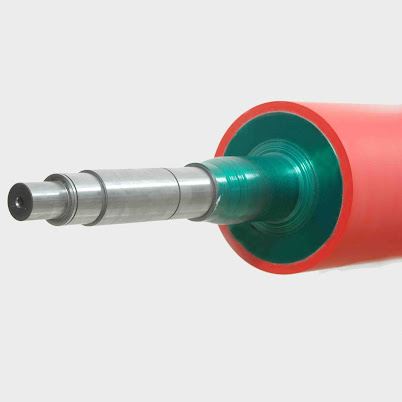
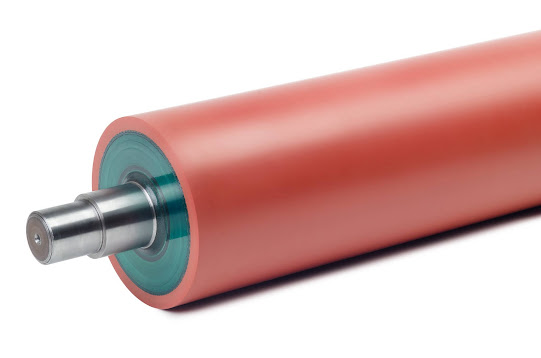
There are three manufacturing processes for making rubber rollers for many uses across various sectors. It includes.
Casting processes are only for manufacturing rubber rollers with metallic cores. Cores are formed by a metal casting process like stamping and later bound to a rubber coating with bonding agents made of polymer-solvent solutions.
Rubber roller molding processes include compression and injection molding for making solid rollers
The extrusion process of rubber rollers is when manufacturers heat the selected elastomeric materials and squeeze the molten material through the die with a pin in the center to fabricate the hollow tube.
Grooving is the next step of making grooved rubber rollers out of any three of the above processes. The rubber surface of the rollers can have a variety of grooves in many shapes. It includes a square, "V," trapezoidal, half-circle, round, double edge saw. It is also possible to make these grooves horizontally, vertically, worm, diamond, and screw threaded. Apart from the use of wrinkle-free spreading of thin films, they also mitigate slipping of films and release the heat during usage. The special groove cut rubber rollers mostly find applications in the printing and packaging industry like high-speed flexographic printing. Also, they find application in many other sectors like steel, textile, plastic, and lamination industry.
Vintex Rollers is the leading supplier and exporter of all kinds of rubber rollers for use in many industries. They make customized rubber rollers with after-sales services like high-quality grooving, making them the preferred choice in India and worldwide. Apart from grooving, the after-sales service includes quick re-rubberization, repair, crowing, grinding, balancing among others, in many places in India and with partners in the UK and Japan.
For further information or any queries about rollers, please feel free to contact us on info@vintexrollers.com or https://www.vintexrollers.com/contact-us/
Mayank Chhabra
Director
Vintex Rubber Industries
Comments
Post a Comment